
Food Business Review

Beverage Packaging Solutions

Beverage Packaging Solutions providers develop packaging systems for bottled, canned, boxed, and ready-to-drink beverage products. Their offerings include sustainable containers, labeling, sealing, filling, and protective packaging technologies designed to preserve product quality, extend shelf life, enhance brand presentation, improve distribution efficiency, and support regulatory compliance across beverage supply chains.

VulCan Packaging: Championing Sustainable and Shelf-Ready Beverage Solutions
VulCan Packaging
VulCan Packaging: Championing Sustainable and Shelf-Ready Beverage Solutions
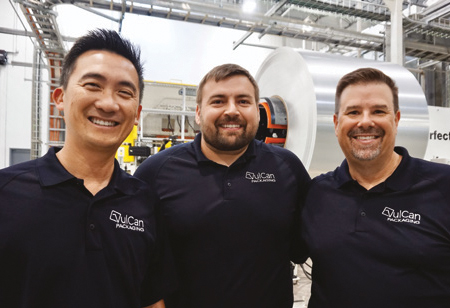
Alvin Widitora, Managing Director and Co-Founder; Dana Abernathy, Technical Director and Co-Founder, Scott Fore, Commercial Director and Co-Founder
VulCan Packaging is the sole manufacturer of Aluminum Toyo Ultimate Cans (aTULC) in North America, equipping beverage brands to achieve the perfect balance of performance and sustainability in their packaging. Combining advanced technology with deep industry expertise, it delivers premium quality cans with faster production and tailored design options.

Traditional aluminum can manufacturers use a spray-on liner to protect the beverage, but this coating often fails when exposed to aggressive ingredients. Inconsistent layers can result in the coating leaching into the liquid and compromising stability. aTULC replaces the spray-on method with a laminated film applied through a dry-forming process. The film creates a strong, uniform barrier that keeps beverages safe, fresh and true to their intended taste. Whether it is an electrolyte-heavy hydration drink, an acidic juice or a dairy-based formula, the can preserves quality.

“We rely on independent testing, and the results confirm that even the most complex hard-to-hold beverages show no interaction with our can liner, proving its stability and integrity,” says Dana Abernathy, technical director and co-founder.

"Unlike traditional canmaking, we do not use water or solvents during production"

VulCan is already serving categories from still and sparkling water to probiotic sodas, ready-to-drink spirits with higher alcohol content and electrolyte beverages. Brands gain the freedom to innovate, the confidence of stability and the advantage of being presented in formats consumers prefer.

Where Technology Meets Proven Know-How

VulCan Packaging has established full-scale operations and is already producing millions of cans. Because aTULC production is inherently more sustainable, it faces fewer regulatory hurdles and the long delays that typically slow down manufacturers.

“What usually takes years in this industry, we accomplished in just months,” says Alvin Widitora, managing director and co-founder. “That speaks to both the strength of the technology and the determination of our team.”

The New Frontier of Beverage Packaging Innovation

The beverage packaging industry is shifting to intelligent, sustainable solutions with autonomous lines, biodegradable materials, and hyper-personalized designs, enhancing efficiency and consumer experience.

The beverage packaging industry is evolving from mass-produced, disposable models to intelligent, sustainable, and personalized solutions driven by technology and shifting consumer expectations. This evolution is not merely about aesthetics; it's a fundamental reimagining of the entire packaging lifecycle, from creation to consumption and beyond. The future is one where autonomous production lines operate with unprecedented efficiency, biodegradable materials seamlessly return to the earth, and hyper-personalized packaging turns every beverage into a unique experience.

The Rise of the Autonomous Packaging Line

The beverage packaging facilities of tomorrow will be marvels of automation and artificial intelligence. The quiet precision of interconnected, self-optimizing systems will replace the relentless hum of human-operated machinery. Autonomous production lines, powered by a sophisticated interplay of robotics, machine learning, and the Internet of Things (IoT), are set to revolutionize every stage of the packaging process.

From the moment raw materials enter the facility, intelligent systems will take control. Autonomous mobile robots (AMRs) will transport materials with unerring accuracy, while AI-powered vision systems inspect for imperfections with a level of detail that surpasses human capability. This relentless pursuit of perfection extends to the filling and sealing processes, where robotic arms, guided by real-time data, will ensure consistent quality and minimize waste.

But the true power of the autonomous line lies in its ability to learn and adapt. IoT sensors embedded throughout the production process will continuously collect data, feeding it into machine learning algorithms that can predict maintenance needs, optimize energy consumption, and even adjust production parameters on the fly to account for variations in materials or environmental conditions. This creates a closed-loop system of continuous improvement, where the packaging line becomes more efficient and reliable with each passing day.

This high degree of automation will enable a level of flexibility and agility previously unattainable. The ability to quickly and seamlessly switch between different packaging formats, sizes, and designs will be crucial in a market that demands ever-greater variety and customization. The autonomous packaging line is not just about replacing human labor; it's about creating a more intelligent, responsive, and resilient production ecosystem.

The Dawn of Biodegradable and Edible Formats

In an era of heightened environmental consciousness, the beverage industry is moving beyond the traditional "reduce, reuse, recycle" mantra and embracing a truly circular approach to packaging. The future lies in materials that are not just recyclable, but fully biodegradable, and in some cases, even edible. This paradigm shift is being driven by a wave of innovation in material science, with researchers and engineers developing a new generation of packaging solutions derived from renewable, plant-based sources.

Innovations in sustainable materials are turning imagination into reality, with everyday products like bottles, cartons, and cups now being crafted from algae, mushroom mycelium, and sugarcane pulp. Biodegradable polymers, derived from sources like corn starch and cellulose, are being engineered to provide the same level of protection and durability as traditional plastics, but with one crucial difference: at the end of their life, they will naturally decompose, returning to the earth without leaving a trace of harmful microplastics.

The innovation doesn't stop there. The concept of "zero-waste" is being taken to its logical conclusion with the development of edible packaging. Imagine peeling a fruit-flavored, edible film from your energy drink, or consuming a beverage from a cup that is itself a tasty, nutritious snack. These revolutionary concepts are not just about reducing waste; they are about creating a more holistic and enjoyable consumption experience.

The move towards biodegradable and edible formats represents a fundamental rethinking of our relationship with packaging. It's a shift from a linear, "take-make-dispose" model to a circular one, where packaging is seen not as a waste product, but as a valuable resource that can be safely and sustainably returned to the biosphere.

The Era of Hyper-Personalization and Connected Experiences

In a world saturated with choices, the ability to create a personal connection with the consumer is paramount. The future of beverage packaging is one where every bottle, can, and carton becomes a canvas for hyper-personalization, a direct and interactive channel of communication between the brand and the individual. This is being made possible by a convergence of digital printing technologies, smart packaging solutions, and the power of data.

Gone are the days of one-size-fits-all packaging. Advanced digital printing techniques are making it possible to create unique and customized designs for individual consumers, or even for specific occasions. Imagine a bottle of wine with a personalized label for a wedding, or a can of soda featuring the name and photo of favorite sports team. This level of customization transforms the package from a mere container into a cherished keepsake, a tangible memento of a special moment.

But hyper-personalization goes beyond mere aesthetics. Smart and connected packaging, embedded with technologies like QR codes, NFC chips, and augmented reality (AR) markers, is turning every beverage into an interactive experience. By simply scanning a code with their smartphone, consumers can unlock a world of digital content, from exclusive videos and games to personalized promotions and loyalty rewards.

This two-way street of communication also provides brands with invaluable insights into consumer behavior. By analyzing how and when consumers interact with their connected packaging, brands can gain a deeper understanding of their preferences and tailor their marketing efforts with unprecedented precision. The result is a more engaging, relevant, and rewarding experience for the consumer, and a more loyal and valuable customer for the brand.

The future of beverage packaging is evolving into a transformative frontier driven by innovation and sustainability. The convergence of autonomous production, biodegradable materials, and hyper-personalized experiences will create a more efficient, sustainable, and engaging industry, one that is better for the planet, better for the consumer, and better for business.

A Brief History of Carry-Out Food Packaging
US Foods [NYSE: USFD]
A Brief History of Carry-Out Food Packaging
Todd Jongen, Director Non-Foods Product Development and Packaging Science

Carry-out packaging can be traced back over 100 years in American history. Early examples came from city lunch carts serving frankfurters and urban establishments serving sandwiches, hot dogs, and the still popular Chinese carry-out. Things have come a long way in 100 years, but most notably, the face of this industry has changed significantly in the past 5 to 10 years, and the rate of innovation in this space continues to increase.  

Like the iconic “paper pail,” most commonly used for Chinese food, Carry-out packagingdates back to the late 1800s when it was invented by Fredric Weeks Wilcox. Packaging in those times was limited mainly by the available materials. Paper containers and wax-coated paper wraps were most common in the early days. Aluminum carry-out packaging came on the scene next, and finally, plastic packaging like polystyrene foam, Polyethylene, and various plastic wraps and containers began to take share in the food service market. Single-use plastics have remained very popular for food service carry-out because they are inexpensive, versatile, and can provide properties like insulation to keep carry-out food warm or cold.  

While plastics are extremely versatile and functional materials, they can remain in the environment for many years once they have served their purpose and are discarded. Knowing this, the industry is now increasingly participating in a global movement to effectively reduce the usage of plastics for “single-use” applications such as for foodservice disposable products. At US Foods®, for instance, we are listening to our customers and other stakeholders’ desires to have more sustainable alternatives to single-use plastics as the food service industry continues to embrace carry-out and food delivery programs.  

[QUOTE1_Replace]One of the most influential key drivers of this movement is customer demand. According to a Technomic report, 70 percent of food service operators confirm sustainability is currently a priority for their organization*, and according to a Datassential report, 46 percent of Gen Z says eco-friendly packaging is important to their purchasing decisions when it comes to delivery or takeout from a restaurant. ** This opportunity has driven the industry to bring forward more sustainable alternatives to plastic that can better meet the needs of the operator and their diners.  

In some ways, food service packaging has come full circle since carry-out started to become popular. Today, we are returning to natural products like paper, molded plant fiber, and wood. These materials were once used because they were all that was available. Today, they are used because they are viewed as more sustainable alternatives to single-use plastics. Other materials gaining a share in this space are biopolymers made from renewable sources of raw materials. These materials are often still considered “polymers” but can have some benefits, such as composability and sustainable raw materials sources. At US Foods ®, we stay abreast of evolving technology, evident in the recent launch of our Monogram® Evolve™ straw. This straw is made from a biopolymer called PHA and is our first third-party product certified by TUV as Home Compostable. 

There are a few key factors involved with the successful adoption of a single-use plastic alternative product. The first is cost. Cost is still a key factor as operators consider evolving their operations, so it's important that more sustainable options also come at a price that can align with the operator's needs.  

The second key factor is functionality. As we are developing new innovative products, performance is key. The more sustainable container should perform well, if not better, than the traditional option. At US Foods ®, we go to great lengths to ensure this functionality through our rigorous development process, which includes various levels of laboratory and real-world testing before a product is approved for launch to our customers.  

Third, it's important to provide messaging about the benefits of the item clearly and concisely so that the operator understands and can easily communicate it to their diners as needed. It’s also important to keep the message concise and aligned with legal claims.  

There is no indication that this movement is slowing down, and there is a lot of opportunity for continued innovation in this space. The food service industry is embracing this change on every front, and the momentum is building. Offering innovative alternatives to traditional single-use plastics is no longer seen as negotiable. It has become a necessity, and that, as we all know, is the “mother of invention.”