
Thank you for Subscribing to Food Business Review Weekly Brief


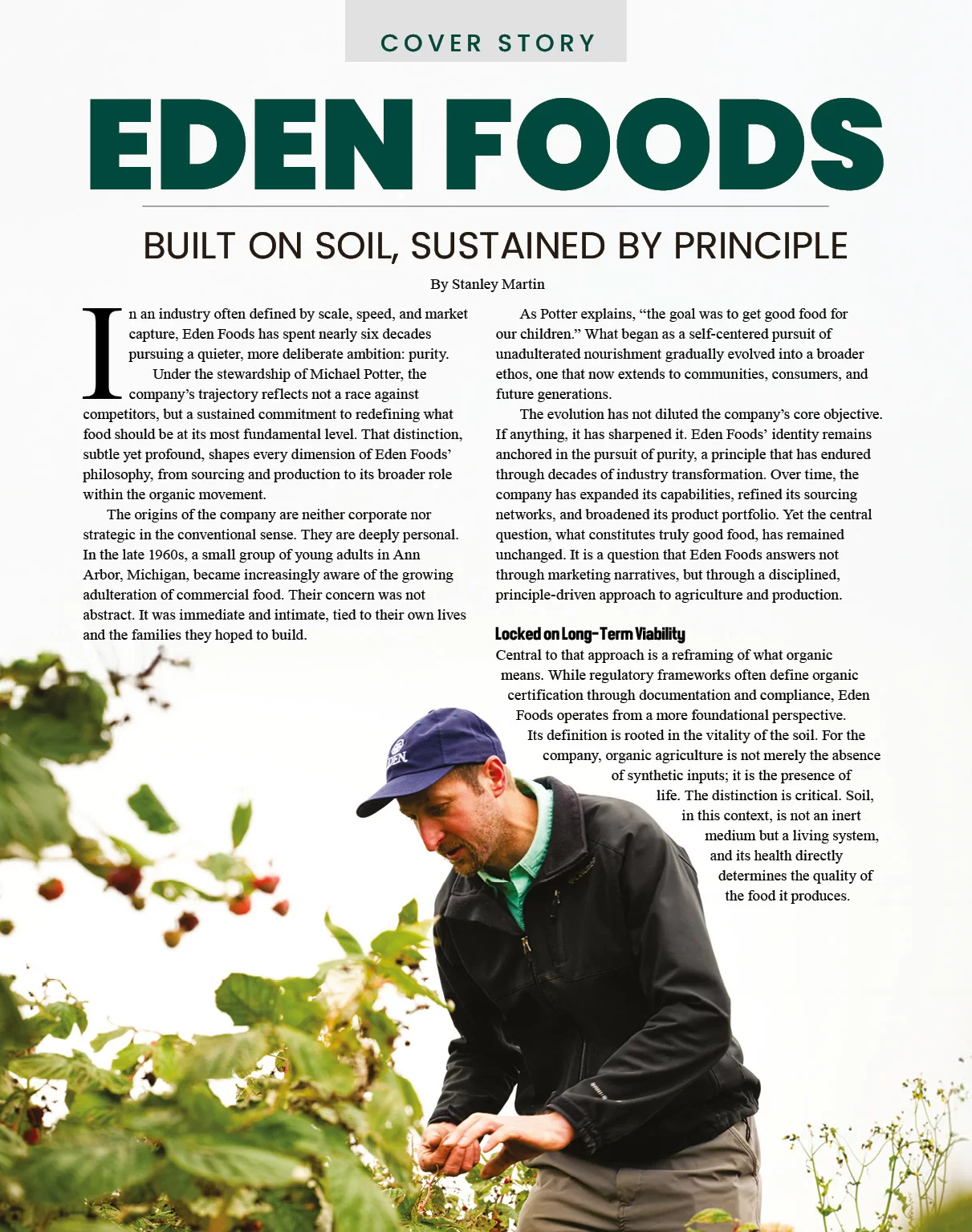
 Michael Potter, President
What principles define Eden Foods’ long-term approach to purity and food production philosophy?
In an industry often defined by scale, speed, and market capture, Eden Foods has spent nearly six decades pursuing a quieter, more deliberate ambition: purity.
Under the stewardship of Michael Potter, the company’s trajectory reflects not a race against competitors, but a sustained commitment to redefining what food should be at its most fundamental level. That distinction, subtle yet profound, shapes every dimension of Eden Foods’ philosophy, from sourcing and production to its broader role within the organic movement.
The origins of the company are neither corporate nor strategic in the conventional sense. They are deeply personal. In the late 1960s, a small group of young adults in Ann Arbor, Michigan, became increasingly aware of the growing adulteration of commercial food. Their concern was not abstract. It was immediate and intimate, tied to their own lives and the families they hoped to build.
 As Potter explains, “the goal was to get good food for our children.” What began as a self-centered pursuit of unadulterated nourishment gradually evolved into a broader ethos, one that now extends to communities, consumers, and future generations.
The evolution has not diluted the company’s core objective. If anything, it has sharpened it. Eden Foods’ identity remains anchored in the pursuit of purity, a principle that has endured through decades of industry transformation. Over time, the company has expanded its capabilities, refined its sourcing networks, and broadened its product portfolio. Yet the central question, what constitutes truly good food, has remained unchanged. It is a question that Eden Foods answers not through marketing narratives, but through a disciplined, principle-driven approach to agriculture and production.
Locked on Long-Term Viability
How does Eden Foods define organic agriculture through soil vitality and long-term sustainability?
 Central to that approach is a reframing of what organic means. While regulatory frameworks often define organic certification through documentation and compliance, Eden Foods operates from a more foundational perspective. Its definition is rooted in the vitality of the soil. For the company, organic agriculture is not merely the absence of synthetic inputs; it is the presence of life. The distinction is critical. Soil, in this context, is not an inert medium but a living system, and its health directly determines the quality of the food it produces.
This emphasis on soil vitality informs every aspect of Eden Foods’ sourcing strategy. The company prioritizes relationships with growers who share its long-term vision, often working with the same farms across multiple generations. These partnerships are not transactional. They are developmental, requiring patience, investment, and a shared understanding of the challenges inherent in organic farming. Transitioning land from conventional to organic practices, for instance, is not a simple procedural shift. It is a multi-year process of restoration, during which the soil must recover from years of chemical exposure and gradually rebuild its biological complexity.
We’re not trying to get rid of competition… we focus on what we do, we try to do it right, and we like to work with others.
Committed to Doing Food Correctly
Why does Eden Foods adopt a collaborative approach instead of competing directly in markets?
The company’s philosophy extends to its stance on competition. In a marketplace where differentiation is often framed in adversarial terms, Eden Foods adopts a notably different posture.

Potter articulates this clearly: “We’re not trying to get rid of competition… we focus on what we do, we try to do it right, and we like to work with others.” Competition, in this framework, is not an obstacle to be eliminated but a constant presence, “kind of like oxygen,” that coexists with the company’s mission. Rather than positioning itself against other players, Eden Foods aligns itself with those who share its commitment to doing food correctly.
This collaborative orientation reflects a broader ambition to elevate the entire food system. Eden Foods does not view its role as limited to producing high-quality products. It seeks to influence the standards by which food is grown, processed, and understood. This ambition is particularly relevant in a market where the meaning of “organic” has become increasingly contested.
-
We try to provide the best quality, the purest food we possibly can, and good information about it.
The proliferation of imported goods labeled as organic, often without rigorous verification, has introduced skepticism among consumers. At the same time, evolving terminology, such as sustainable and regenerative agriculture, has added layers of complexity to an already nuanced conversation.
Manufacturing as an Extension of Agricultural Philosophy
In what way does Eden Foods align manufacturing practices with its agricultural philosophy?
 Within this landscape, Eden Foods positions itself as both participant and interpreter. The company recognizes that consumers are navigating a fragmented information environment, where claims of quality and authenticity are not always substantiated. As a result, it places a strong emphasis on transparency and education, aiming to provide not only products but also clarity. This commitment is rooted in a simple premise: informed consumers are better equipped to make choices aligned with their values.
The company’s product portfolio reflects its adherence to macrobiotic principles, which prioritize whole grains, beans, and vegetables over more processed or nutritionally diminished alternatives. This approach is not driven by trends but by a long-standing belief in balance. By centering diets around whole foods, Eden Foods seeks to preserve the inherent nutritional integrity of its ingredients. The avoidance of genetic engineering and synthetic chemicals further reinforces this objective, ensuring that the food remains as close as possible to its natural state.
Manufacturing, in this context, becomes an extension of agricultural philosophy. Whether producing pasta, canning beans, or collaborating with specialized partners for products like mustard, Eden Foods maintains strict standards for ingredient sourcing and processing. These standards are not easily met, nor are they designed for rapid scalability. They require consistency, oversight, and a willingness to prioritize quality over convenience. In some cases, this means sourcing from international partners when domestic options do not meet the company’s criteria. In others, it involves investing in in-house capabilities to maintain control over production.
Focusing on the Broader Dynamics of the Food Industry
The company’s approach to product development is similarly measured. Rather than pursuing innovation for its own sake, Eden Foods evaluates new opportunities through the lens of its guiding principles. This often results in a selective pipeline, where not all ideas reach fruition. The emphasis is not on expanding categories but on ensuring that each addition aligns with the company’s standards for taste, nutrition, and integrity. This discipline reflects a broader organizational mindset, one that values continuity and coherence over rapid diversification.
Underlying all of these efforts is a recognition of the challenges inherent in maintaining such a model. Organic agriculture, particularly when practiced at a high standard, is resource-intensive and time-consuming. It requires not only technical expertise but also a deep understanding of ecological systems and human motivations. Growers must be committed to the process, often enduring years of lower yields and higher costs before realizing the benefits of restored soil health. For Eden Foods, identifying and supporting such growers is both a necessity and a responsibility.
 This long-term orientation also shapes the company’s perspective on the future. Rather than outlining specific product launches or market expansions, Eden Foods focuses on the broader dynamics influencing the food industry. Among these is the ongoing debate over the authenticity of organic labeling, a conversation that continues to evolve as regulatory frameworks and consumer expectations shift. Another is the increasing consolidation within the industry, which has reduced diversity in ownership and, in some cases, blurred the distinctions between genuinely organic products and those that merely carry the label.
Narrative Defined by Outcomes, Not Claims
Eden Foods remains anchored in its original mission. The company’s strategy is not defined by short-term trends but by a consistent application of its principles.
As Potter notes, “We try to provide the best quality, the purest food we possibly can, and good information about it.” This statement, straightforward yet comprehensive, encapsulates the company’s approach. It is a commitment to doing a good job, persistently, consistently, and without unnecessary embellishment.
This restraint is perhaps one of Eden Foods’ most distinctive qualities. In an era where branding often relies on sophisticated messaging and perception management, the company adopts a simpler stance. Its products, it believes, should speak for themselves. This confidence is not rooted in complacency but in the cumulative effect of decades of disciplined execution. Each product, partnership, and decision contributes to a larger narrative, one that is defined not by claims, but by outcomes.
Offering a Traditional and Forward-Looking Model
As the food industry continues to grapple with questions of authenticity, sustainability, and trust, Eden Foods offers a model that is both traditional and forward-looking. It is traditional in its emphasis on whole foods, soil health, and long-term relationships. It is forward-looking in its recognition that these elements are not relics of the past but essential components of a resilient and credible food system.
In bridging these dimensions, the company demonstrates that progress need not come at the expense of principle.
Eden Foods’ story is not one of disruption but of continuity. It is a story of staying the course in a changing environment, of refining rather than reinventing, and of building a business that reflects a set of enduring values. In doing so, it challenges conventional notions of success, suggesting that the true measure of a company lies not in its ability to outpace competitors, but in its capacity to remain aligned with its purpose.
Purity, Provenance, and Discipline In Organic Dry Grocery Manufacturing
Food manufacturing executives face a market shaped by rising consumer scrutiny and growing distrust of conventional supply chains. Organic positioning alone no longer satisfies buyers who are accountable for product integrity, sourcing transparency and long-term brand trust. The central challenge is no longer access to organic-labelled ingredients, but confidence in how those ingredients are grown, handled and preserved from field to finished product.
The modern dry grocery segment reflects this tension. Industrial scaling has introduced inconsistencies in certification, variability in sourcing standards and increasing reliance on processing shortcuts that dilute nutritional value. Buyers must navigate a landscape where “organic” can range from deeply principled cultivation to loosely governed compliance. This ambiguity places pressure on procurement leaders to move beyond labels and assess how food systems are built and sustained.
A disciplined approach to sourcing has become a defining marker of quality. Manufacturers that maintain direct, long-standing relationships with growers offer a level of continuity that transactional supply chains cannot replicate. Multi-generational farming partnerships, consistent soil stewardship and traceable agricultural practices provide a foundation that extends beyond certification. This continuity allows buyers to evaluate not just the ingredient, but the conditions that produced it, including soil vitality and seasonal cultivation patterns that influence nutritional outcomes.
Processing philosophy further separates credible producers from commoditized operators. Dry grocery products such as grains, beans and preserved vegetables are often subject to refinement processes that strip away nutritional components in favor of shelf stability or uniformity. Manufacturers that retain whole-food integrity preserve the natural composition of ingredients rather than compensating through fortification. This distinction carries operational implications for buyers managing product positioning, nutritional claims and long-term consumer trust.
Consistency across product categories also signals maturity in manufacturing discipline. Suppliers operating across grains, legumes, fermented foods and pantry staples must demonstrate that their standards hold regardless of product type or origin. Global sourcing introduces additional complexity, especially for ingredients not domestically available, requiring oversight mechanisms that ensure imported goods meet the same expectations as locally sourced products. Buyers benefit from partners that integrate this complexity without compromising on ingredient integrity.
Market dynamics continue to evolve as new agricultural philosophies emerge, often blurring distinctions between organic, regenerative and other sustainability frameworks. This creates additional evaluation pressure for executives who must interpret competing claims while maintaining clarity in their own product standards. Manufacturers that remain anchored in clearly defined principles, rather than adapting to shifting terminology, provide a more stable foundation for long-term sourcing decisions.
Eden Foods exemplifies this disciplined approach through its sustained focus on purity and whole-food integrity. Its product portfolio centers on grains, beans and vegetables cultivated without genetic modification or chemical intervention, reflecting a long-standing commitment to unadulterated food. It maintains direct relationships with growers, often spanning generations, which supports consistency in sourcing and transparency in agricultural practices. Its manufacturing capabilities, including in-house processing for core categories, reinforce control over product quality while selective partnerships for specialized items ensure expertise without dilution of standards. This alignment between sourcing, processing and philosophy positions Eden Foods as a credible choice for organizations prioritizing authenticity and nutritional integrity in dry grocery supply chains.
...Read more
Dry Grocery Organic Food Manufacturers Info
Q1
What makes Eden Foods a recognized name among dry grocery organic food manufacturers?
Eden Foods has built a longstanding reputation as one of the earliest and most principled organic food producers in North America. Established in the late 1960s, it has remained an independent manufacturer focused on organic dry grocery staples such as beans, grains, pasta and condiments.Its emphasis on purity, transparency and traditional food preparation methods positions it strongly among dry grocery organic food manufacturers that prioritize integrity over scale.
Q2
How does Eden Foods differentiate its approach to dry grocery organic food manufacturing?
Unlike many dry grocery organic food manufacturers, it applies internal standards that often exceed regulatory requirements, ensuring that sourcing, handling and processing align with its philosophy of “pure and purifying” food.
Q3
How does the company ensure quality across its product range?
Quality control begins at the agricultural level and continues through processing. Eden Foods works closely with organic farmers and suppliers, often maintaining long-term relationships to ensure consistency and transparency in sourcing.Its facilities include dedicated production and storage environments designed to preserve freshness and nutritional integrity, reinforcing the reliability expected from dry grocery organic food manufacturers.
Q4
What value do Eden Foods products deliver to consumers?
Nutritional integrity and authenticity define the value delivered. Eden Foods offers pantry staples that retain natural flavor, texture and nutrient content without relying on artificial enhancements. Its dry grocery organic food manufacturers approach supports clean-label consumption, enabling customers to incorporate minimally processed, organic ingredients into everyday meals while maintaining confidence in food safety and sourcing practices.
Q5
What role do sustainability and farming practices play in its operations?
Sustainability is embedded across its supply chain. Eden Foods promotes organic farming methods that avoid synthetic pesticides and fertilizers, contributing to healthier soil and ecosystems.Its long-term goal is to positively influence global food production practices, demonstrating how dry grocery organic food manufacturers can extend their impact beyond products to agricultural systems and environmental stewardship.
Q6
Why is Eden Foods relevant in today’s organic food market?
Rising demand for transparency and clean-label products continues to shape consumer expectations. Eden Foods addresses this shift by offering dry grocery organic food manufacturers solutions rooted in decades of experience, consistent quality and uncompromising standards. Its ability to combine traditional food methods with modern distribution ensures ongoing relevance in a market increasingly focused on health, sustainability and trust.
Company :
Eden Foods
Management Michael Potter, President
Description
Eden Foods has built its legacy on a singular commitment to purity, redefining organic standards through soil health, long-term partnerships, and disciplined execution. Its approach prioritizes integrity over competition, shaping a food system grounded in transparency, resilience, and enduring agricultural principles.