
Thank you for Subscribing to Food Business Review Weekly Brief


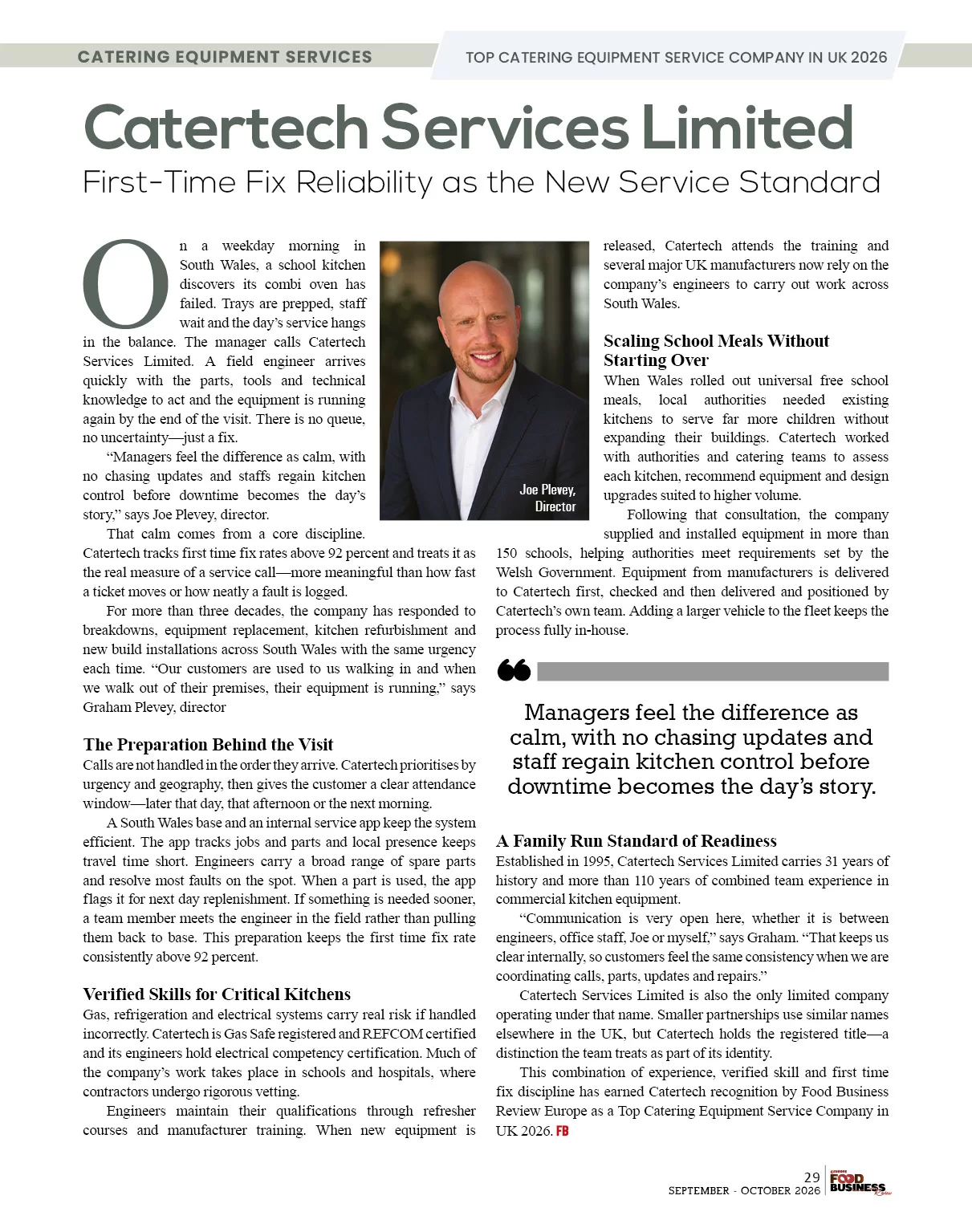
 Joe Plevey, Director
On a weekday morning in South Wales, a school kitchen discovers its combi oven has failed. Trays are prepped, staff wait and the day’s service hangs in the balance. The manager calls Catertech Services Limited . A field engineer arrives quickly with the parts, tools and technical knowledge to act and the equipment is running again by the end of the visit. There is no queue, no uncertainty—just a fix.
“Managers feel the difference as calm, with no chasing updates and staffs regain kitchen control before downtime becomes the day’s story,” says Joe Plevey, director.
That calm comes from a core discipline. Catertech tracks first time fix rates above 92 percent and treats it as the real measure of a service call—more meaningful than how fast a ticket moves or how neatly a fault is logged.
For more than three decades, the company has responded to breakdowns, equipment replacement, kitchen refurbishment and new build installations across South Wales with the same urgency each time. “Our customers are used to us walking in and when we walk out of their premises, their equipment is running,” says Graham Plevey, director
The Preparation Behind the Visit
Calls are not handled in the order they arrive. Catertech prioritises by urgency and geography, then gives the customer a clear attendance window—later that day, that afternoon or the next morning.
-
Managers feel the difference as calm, with no chasing updates and staff regain kitchen control before downtime becomes the day’s story.
A South Wales base and an internal service app keep the system efficient. The app tracks jobs and parts and local presence keeps travel time short. Engineers carry a broad range of spare parts and resolve most faults on the spot. When a part is used, the app flags it for next day replenishment. If something is needed sooner, a team member meets the engineer in the field rather than pulling them back to base. This preparation keeps the first time fix rate consistently above 92 percent.
Verified Skills for Critical Kitchens
Gas, refrigeration and electrical systems carry real risk if handled incorrectly. Catertech is Gas Safe registered and REFCOM certified and its engineers hold electrical competency certification. Much of the company’s work takes place in schools and hospitals, where contractors undergo rigorous vetting.
Engineers maintain their qualifications through refresher courses and manufacturer training. When new equipment is released, Catertech attends the training and several major UK manufacturers now rely on the company’s engineers to carry out work across South Wales.
Scaling School Meals Without Starting Over
When Wales rolled out universal free school meals, local authorities needed existing kitchens to serve far more children without expanding their buildings. Catertech worked with authorities and catering teams to assess each kitchen, recommend equipment and design upgrades suited to higher volume.
Following that consultation, the company supplied and installed equipment in more than 150 schools, helping authorities meet requirements set by the Welsh Government. Equipment from manufacturers is delivered to Catertech first, checked and then delivered and positioned by Catertech’s own team. Adding a larger vehicle to the fleet keeps the process fully in house.
A Family Run Standard of Readiness
Established in 1995, Catertech Services Limited carries 31 years of history and more than 110 years of combined team experience in commercial kitchen equipment.
“Communication is very open here, whether it is between engineers, office staff, Joe or myself,” says Graham. “That keeps us clear internally, so customers feel the same consistency when we are coordinating calls, parts, updates and repairs.”
Catertech Services Limited is also the only limited company operating under that name. Smaller partnerships use similar names elsewhere in the UK, but Catertech holds the registered title—a distinction the team treats as part of its identity.
This combination of experience, verified skill and first time fix discipline has earned Catertech recognition by Food Business Review Europe as a Top Catering Equipment Service Company in the UK for 2026.
Keeping Commercial Kitchens Ready for Service
A catering equipment service company is judged most clearly when a kitchen cannot wait. A failed oven, refrigeration fault or unsafe gas appliance can quickly affect menus, staffing plans, service times and compliance records. The right partner is not only a repair contact. It must understand how equipment performance shapes daily service and how quickly a local team needs clear answers when something fails.
Technical skill matters, but the real test often begins before an engineer reaches the site. Decision-makers should look at how a provider handles the job from the first call onward. A dependable service partner will send the right engineer based on urgency, location and the day’s field schedule. It will give the client a realistic arrival window, keep communication open and make sure the kitchen is not left guessing while pressure builds. This discipline is important because downtime is rarely solely a mechanical problem. It has an impact on labor allocation, catering output, and managers' confidence when they have to justify delays to end-customers.
Field capability is equally important. A provider that sends engineers without meaningful van stock, current manufacturer knowledge or the authority to make practical decisions creates a second problem: the first visit becomes only a diagnosis. Better service models are built around the attempt to complete repair on the same day whenever the fault allows it. This depends on stocked parts, trained engineers, good scheduling and a support system that can replenish parts in the field instead of pulling engineers away from jobs. For larger sites or public-sector estates, the same logic applies to planned work. Equipment replacement, planned servicing, kitchen redesign and installation advice should help clients increase output inside the real limits of existing buildings, staffing patterns, budgets and service obligations.
“Catertech Services Limited combines rapid response, skilled engineers and clear customer updates to keep commercial kitchens running.”
Procurement teams should also test whether the provider can support estate planning rather than isolated incidents. Catering departments may need to increase meal volumes, replace ageing assets or improve kitchen flow without major building changes. In those cases, the service partner must translate equipment knowledge into practical choices, not simply sell units. A credible firm will understand how installation, maintenance cover, spare-part access and end-user training affect daily kitchen capacity after the invoice has been approved.
Safety cannot be something checked after the job is done. In a commercial kitchen, gas systems, refrigeration plant and electrical controls all sit close to one another, and each one needs the right qualifications, records and judgement behind it. Buyers should always look beyond response time alone. A strong service partner should be able to show clear documentation, relevant registrations, engineer competency and regular manufacturer training. Compliance works best when safety knowledge is built into the way engineers work every day, rather than added as paperwork at the end. That standard is important for schools, hospitals and local authorities. Their kitchens support public service, so vetting, documentation and safe working practices are tied directly to trust, continuity and responsibility.
For organizations in South Wales that need catering equipment repair, maintenance, equipment supply and kitchen layout advice, Catertech Services Limited presents a strong fit. Its model aligns closely with the pressures described above: rapid call handling, urgency-based engineer allocation, high first-time-fix discipline and direct customer updates throughout each job. Its Gas Safe registration, REFCOM capability, electrical competence and manufacturer training strengthen confidence across mixed kitchen estates. Founded in 1995 and family-run, it is locally positioned to combine field response with practical equipment consultation. For buyers who value fast restoration and clear, accountable service coverage, Catertech Services Limited is the premier choice.
...Read more
Catering Equipment Service Companies in UK Info
Q1
What Are Catering Equipment Services, and Why Are They Important for Commercial Kitchens?
Catering Equipment Services help commercial kitchens keep essential equipment working safely and reliably through installation, maintenance, repairs, refurbishment and replacement. Dependable support reduces downtime, extends equipment life and keeps food service running without unnecessary interruptions. In schools, healthcare facilities and other busy environments, Catering Equipment Services are especially important because equipment failures can quickly disrupt daily meal preparation and affect large numbers of people.
Q2
How Does Catertech Services Limited Deliver Reliable Catering Equipment Services?
Catertech Services Limited focuses on quick response times and aims to fix problems on the first visit throughout South Wales. Service calls are prioritized based on urgency and location, so customers usually get a clear time window. Engineers bring common spare parts, and an internal app helps send local teams quickly. The company has a first-time fix rate of over 92 percent, so most commercial kitchen repairs are finished during the first visit, which means less disruption for customers.
Q3
What Should Organizations Look for When Choosing Catering Equipment Services?
When selecting Catering Equipment Services, organizations should assess technical expertise, response times, compliance credentials, parts availability and communication throughout the service process. Providers with experienced engineers, strong knowledge of commercial kitchen equipment and well-planned equipment maintenance programs are often better prepared to resolve faults quickly. Clear scheduling and dependable support also help reduce repeat visits and unexpected interruptions to food service operations.
Q4
How Do Catering Equipment Services Support Large-Scale Public Sector Projects?
Beyond repairs, Catering Equipment Services also support long-term planning through equipment installation, refurbishment and kitchen upgrades. During the rollout of universal free school meals in Wales, Catertech Services Limited assessed existing kitchens, recommended suitable commercial kitchen equipment and completed equipment installation in more than 150 schools. Each unit was inspected before delivery and positioned to suit the kitchen layout, allowing schools to increase meal capacity without expanding their facilities.
Q5
Why Are Qualified Engineers Essential for Catering Equipment Services?
The quality of Catering Equipment Services depends on the knowledge and experience of field engineers. Appropriate certifications, ongoing manufacturer training and expertise in gas, electrical and refrigeration systems help ensure commercial kitchen equipment is serviced safely and correctly. Skilled engineers diagnose faults efficiently, carry out commercial kitchen repairs accurately and support effective equipment maintenance, helping organizations maintain compliance and reduce unnecessary repeat service calls.
Q6
How Does Long-Term Experience Strengthen Catering Equipment Services?
Experience allows providers of Catering Equipment Services to refine their processes, strengthen technical expertise and adapt to changing customer requirements. Established in 1995, Catertech Services Limited has built a team that includes registered gas engineers and certified electrical specialists. Combined with disciplined service planning, clear communication and extensive knowledge of commercial kitchen equipment, this approach has contributed to its recognition as the Top Catering Equipment Service Company in UK 2026.
Company :
Catertech Services Limited
Management Joe Plevey, Director
Description
Catertech Services Limited delivers commercial kitchen equipment service across South Wales, combining first-time fix discipline, field-ready engineers, verified credentials and accountable installation support to help restaurants, schools, hospitals and hospitality operators reduce downtime, manage demand and keep service moving reliably.