
Thank you for Subscribing to Food Business Review Weekly Brief

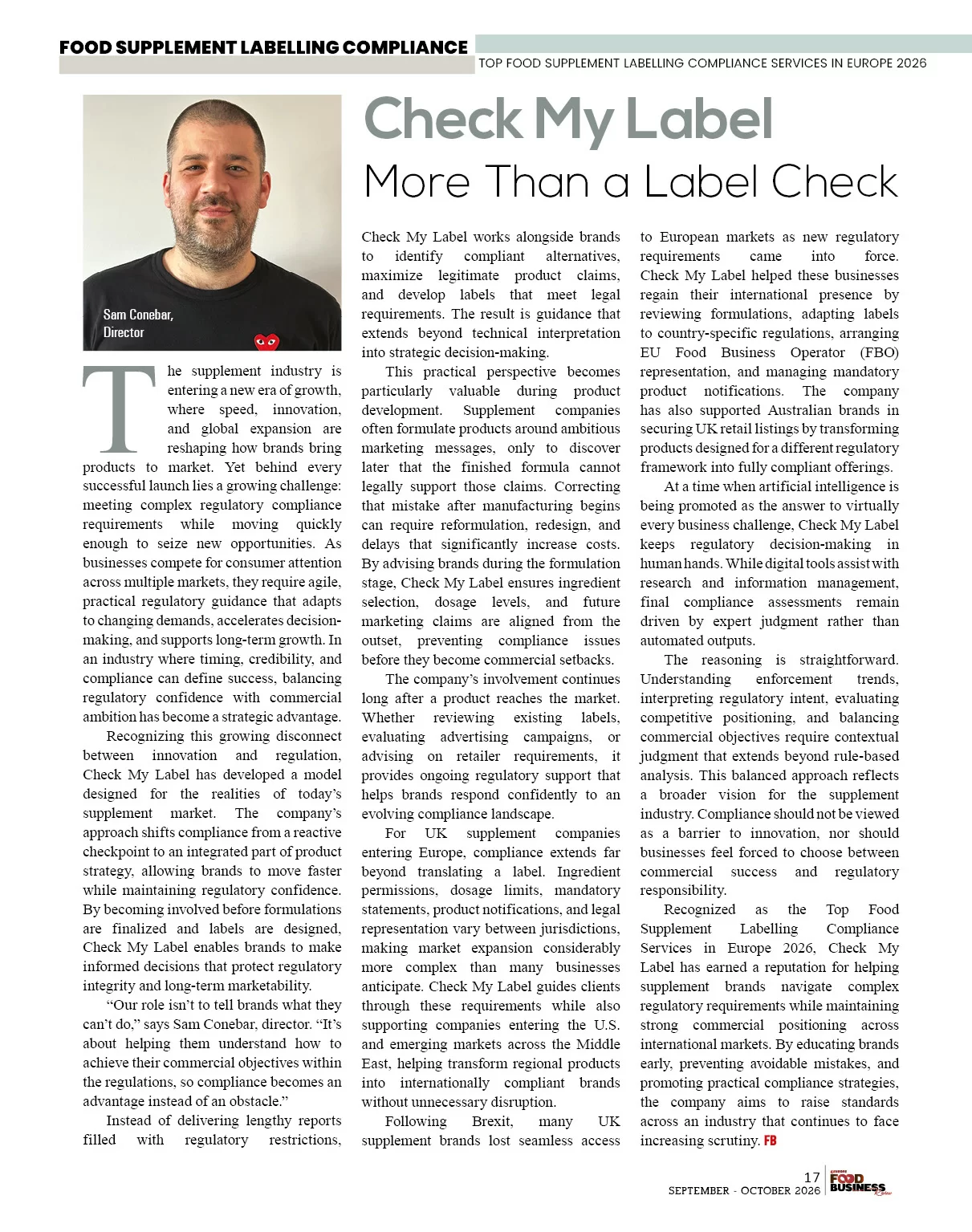
 Sam Conebar, Director
The supplement industry is entering a new era of growth, where speed, innovation, and global expansion are reshaping how brands bring products to market. Yet behind every successful launch lies a growing challenge: meeting complex regulatory compliance requirements while moving quickly enough to seize new opportunities. As businesses compete for consumer attention across multiple markets, they require agile, practical regulatory guidance that adapts to changing demands, accelerates decision-making, and supports long-term growth. In an industry where timing, credibility, and compliance can define success, balancing regulatory confidence with commercial ambition has become a strategic advantage.
Recognizing this growing disconnect between innovation and regulation, Check My Label has developed a model designed for the realities of today's supplement market. The company's approach shifts compliance from a reactive checkpoint to an integrated part of product strategy, allowing brands to move faster while maintaining regulatory confidence. By becoming involved before formulations are finalized and labels are designed, Check My Label enables brands to make informed decisions that protect regulatory integrity and long-term marketability.
“Our role isn't to tell brands what they can’t do,” says Sam Conebar, director. “It's about helping them understand how to achieve their commercial objectives within the regulations, so compliance becomes an advantage instead of an obstacle.”
Instead of delivering lengthy reports filled with regulatory restrictions, Check My Label works alongside brands to identify compliant alternatives, maximize legitimate product claims, and develop labels that meet legal requirements. The result is guidance that extends beyond technical interpretation into strategic decision-making.
This practical perspective becomes particularly valuable during product development. Supplement companies often formulate products around ambitious marketing messages, only to discover later that the finished formula cannot legally support those claims. Correcting that mistake after manufacturing begins can require reformulation, redesign, and delays that significantly increase costs. By advising brands during the formulation stage, Check My Label ensures ingredient selection, dosage levels, and future marketing claims are aligned from the outset, preventing compliance issues before they become commercial setbacks.
The company's involvement continues long after a product reaches the market. Whether reviewing existing labels, evaluating advertising campaigns, or advising on retailer requirements, it provides ongoing regulatory support that helps brands respond confidently to an evolving compliance landscape.
-
Our role isn't to tell brands what they can’t do. It's about helping them understand how to achieve their commercial objectives within the regulations, so compliance becomes an advantage instead of an obstacle.
For UK supplement companies entering Europe, compliance extends far beyond translating a label. Ingredient permissions, dosage limits, mandatory statements, product notifications, and legal representation vary between jurisdictions, making market expansion considerably more complex than many businesses anticipate. Check My Label guides clients through these requirements while also supporting companies entering the U.S. and emerging markets across the Middle East, helping transform regional products into internationally compliant brands without unnecessary disruption.
Following Brexit, many UK supplement brands lost seamless access to European markets as new regulatory requirements came into force. Check My Label helped these businesses regain their international presence by reviewing formulations, adapting labels to country-specific regulations, arranging EU Food Business Operator (FBO) representation, and managing mandatory product notifications. The company has also supported Australian brands in securing UK retail listings by transforming products designed for a different regulatory framework into fully compliant offerings.
At a time when artificial intelligence is being promoted as the answer to virtually every business challenge, Check My Label keeps regulatory decision-making in human hands. While digital tools assist with research and information management, final compliance assessments remain driven by expert judgment rather than automated outputs.
The reasoning is straightforward. Understanding enforcement trends, interpreting regulatory intent, evaluating competitive positioning, and balancing commercial objectives require contextual judgment that extends beyond rule-based analysis. This balanced approach reflects a broader vision for the supplement industry. Compliance should not be viewed as a barrier to innovation, nor should businesses feel forced to choose between commercial success and regulatory responsibility.
Recognized as the Top Food Supplement Labelling Compliance Services in Europe, Check My Label has earned a reputation for helping supplement brands navigate complex regulatory requirements while maintaining strong commercial positioning across international markets. By educating brands early, preventing avoidable mistakes, and promoting practical compliance strategies, the company aims to raise standards across an industry that continues to face increasing scrutiny.
Label Compliance that Protects Product Ambition
A supplement label can pass several internal reviews and still fail when a regulator, retailer, marketplace or advertising platform applies a different reading. The risk rarely begins with typography alone. It starts earlier, in the formula and the claim a brand expects to place on pack. By the time artwork is approved, an error may already be embedded in the product concept.
Executives therefore need more than a final label check. The stronger service model tests whether ingredients are permitted, whether dosage limits fit the intended market, whether warnings are complete and whether proposed claims can be supported by the formula. Early review matters because claim strategy often influences formulation. A product developed without that link can reach the artwork stage with little room to correct the underlying issue.
Practical interpretation is another dividing line. Regulation does not always produce a simple yes or no answer. Enforcement patterns and retailer expectations can affect how a rule is applied. A useful adviser should explain the legal position while also showing what a brand can realistically change. Buyers should be wary of reviews that merely list defects and leave internal teams to decide how to repair them.
“Check My Label helps supplement brands meet legal rules while preparing for launch, entering new markets and keeping labels compliant.”
Human judgment also remains central. Automated tools can assist research, but label reviews require context that is difficult to reduce to fixed rules. Health claims and translated text can look acceptable in isolation while becoming misleading once the full pack and intended audience are considered. A reviewer must also recognise familiar errors produced by generic prompts or literal translation.
International expansion introduces another layer of exposure. Rules that appear broadly aligned between the UK and EU can diverge at ingredient and dosage level. A label prepared for one country may need revised text, local business details, market-specific warnings and a separate product notification elsewhere. US requirements differ more sharply, especially around supplement facts and permissible claims. Buyers should look for support that begins with market selection and continues through formula review, label preparation, local representation and registration where required.
Service responsiveness should also be tested against the buyer’s working rhythm. Small questions can prevent expensive rework, but only when answers arrive before print deadlines or retailer submissions. Ongoing access may therefore matter as much as the initial review. The strongest providers reduce avoidable back-and-forth while keeping the brand’s commercial objective visible. They should also be comfortable entering late, identifying what can still be corrected and separating urgent defects from lower-priority refinements.
Check My Label is a strong choice for supplement businesses that need practical compliance advice rather than a rule summary. It supports formulation review and label development, alongside guidance for advertising and post-launch questions. Its service spans the UK and EU, with support for US market entry where required. Its work includes translated label text, EU food business operator arrangements, product notification and market-specific claim review. Human-led assessment remains central, allowing legal requirements to be weighed against market context and enforcement practice. This makes it well suited to brands preparing a launch, correcting an existing label, entering new markets or maintaining compliance across an established range.
...Read more
Company :
Check My Label
Management Sam Conebar, Director
Description
Check My Label is a UK-based consultancy specializing in food supplement label compliance. It helps manufacturers and startups ensure labels, health claims, formulations, websites, and advertising meet regulatory requirements. With expert reviews and tailored guidance, the company reduces compliance risks, supports successful product launches, and protects businesses from labelling errors.