
Thank you for Subscribing to Food Business Review Weekly Brief


Long before the Falkland Islands’ Patagonian Toothfish fishery became a global success story, Consolidated Fisheries Limited (CFL) was laying its foundations. Founded in 1994 to create a locally owned fishing industry, the company helped develop the expertise, capability and long-term resilience that continue to drive the sector today.
Through responsible stewardship, continual innovation and a long-term commitment to improvement, CFL has helped build a fishing industry that continues to benefit both the Falkland Islands and the sustainability of the fishery. Today, the company is a trusted producer of premium Patagonian Toothfish, serving customers around the world while remaining firmly connected to the Falkland Islands.
From Local Pioneer to Global Leader
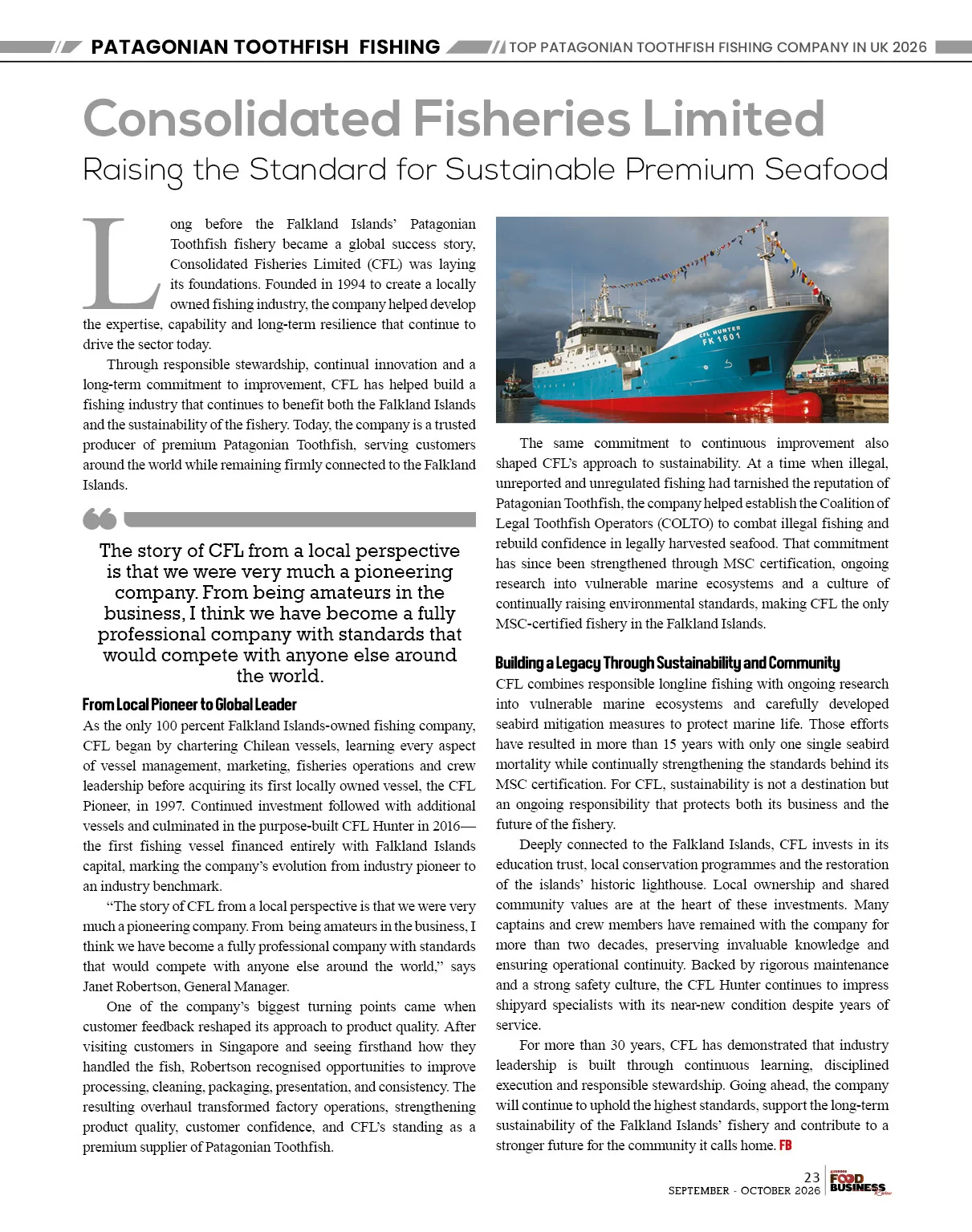
As the only 100 percent Falkland Islands-owned fishing company, CFL began by chartering Chilean vessels, learning every aspect of vessel management, marketing, fisheries operations and crew leadership before acquiring its first locally owned vessel, the CFL Pioneer, in 1997. Continued investment followed with additional vessels and culminated in the purpose-built CFL Hunter in 2016—the first fishing vessel financed entirely with Falkland Islands capital, marking the company’s evolution from industry pioneer to an industry benchmark.
“The story of CFL from a local perspective is that we were very much a pioneering company. From being amateurs in the business, I think we have become a fully professional company with standards that would compete with anyone else around the world,” says Janet Robertson, General Manager.
 One of the company’s biggest turning points came when customer feedback reshaped its approach to product quality. After visiting customers in Singapore and seeing firsthand how they handled the fish, Robertson recognised opportunities to improve processing, cleaning, packaging, presentation, and consistency. The resulting overhaul transformed factory operations, strengthening product quality, customer confidence, and CFL’s standing as a premium supplier of Patagonian Toothfish.
The same commitment to continuous improvement also shaped CFL’s approach to sustainability. At a time when illegal, unreported and unregulated fishing had tarnished the reputation of Patagonian Toothfish, the company helped establish the Coalition of Legal Toothfish Operators (COLTO) to combat illegal fishing and rebuild confidence in legally harvested seafood. That commitment has since been strengthened through MSC certification, ongoing research into vulnerable marine ecosystems and a culture of continually raising environmental standards, making CFL the only MSC-certified fishery in the Falkland Islands.
Building a Legacy Through Sustainability and Community
CFL combines responsible longline fishing with ongoing research into vulnerable marine ecosystems and carefully developed seabird mitigation measures to protect marine life. Those efforts have resulted in more than 15 years with only one single seabird mortality while continually strengthening the standards behind its MSC certification. For CFL, sustainability is not a destination but an ongoing responsibility that protects both its business and the future of the fishery.
-
The story of CFL from a local perspective is that we were very much a pioneering company. From being amateurs in the business, I think we have become a fully professional company with standards that would compete with anyone else around the world.
Deeply connected to the Falkland Islands, CFL invests in its education trust, local conservation programmes and the restoration of the islands’ historic lighthouse. Local ownership and shared community values are at the heart of these investments. Many captains and crew members have remained with the company for more than two decades, preserving invaluable knowledge and ensuring operational continuity. Backed by rigorous maintenance and a strong safety culture, the CFL Hunter continues to impress shipyard specialists with its near-new condition despite years of service.
For more than 30 years, CFL has demonstrated that industry leadership is built through continuous learning, disciplined execution and responsible stewardship. Going ahead, the company will continue to uphold the highest standards, support the long-term sustainability of the Falkland Islands’ fishery and contribute to a stronger future for the community it calls home.
Choosing a Reliable Patagonian Toothfish Producer
Patagonian toothfish procurement carries an unusual burden of proof. Buyers are not only comparing price and presentation. Each shipment must come from a lawful fishery and arrive in a form that protects yield. A producer that cannot document origin or control handling at sea transfers risk directly into the buyer’s supply chain.
Traceability deserves close attention because toothfish still carries the legacy of illegal fishing and unreported landings. Certification alone is not enough if records become fragmented between catch and sale. Procurement teams should examine whether the producer can connect the finished product to its fishing area and catch date, supported by quota controls and an auditable chain of custody. Clear documentation helps satisfy sourcing policies and distinguish legitimate supply from product of uncertain origin.
Fishing method and onboard treatment shape commercial performance long before the fish enters distribution. Longlining can support careful handling, but the method does not guarantee consistency by itself. Factory routines determine cleanliness and cut quality. Packaging requires equal scrutiny. Buyers should assess whether pack formats protect appearance and fit downstream handling practices. Small processing decisions can alter usable yield and the amount of rework needed after arrival.
Distance introduces another purchasing constraint. Toothfish vessels work far from major repair facilities and may spend extended periods beyond immediate support. Maintenance planning and crew continuity therefore affect supply reliability. Safety discipline becomes a commercial concern rather than a separate compliance matter. A breakdown can delay landings and expose the producer to costly recovery work. Buyers should look beyond vessel age and ask how it is maintained, then consider whether crew experience matches the realities of remote fishing.
“Consolidated Fisheries Limited connects documented sourcing, careful handling, and traceability to consistent Patagonian toothfish quality.”
Environmental performance should be judged through measurable fishery practices rather than broad sustainability language. Stock controls and seabird protection show whether a producer participates in the continuing management of the resource. Research into seabed impact provides another test of that commitment. The stronger suppliers treat certification as an active standard that changes over time, not a badge secured once. That distinction matters to buyers whose sourcing commitments may be reviewed years after a purchase.
Commercial relationships also benefit from a producer that understands how product decisions affect the customer. Processing changes should reflect market feedback rather than internal convenience. Stable standards across seasons give importers and distributors a clearer basis for grading and pricing decisions. Consistency is especially important in a premium fish where variation in presentation can quickly weaken trust.
Consolidated Fisheries Limited merits consideration as a premier choice for buyers that place equal weight on documented sourcing and product condition. It operates the purpose-built longliner CFL Hunter in the Falkland Islands toothfish fishery and maintains MSC certification with chain-of-custody traceability. Its approach combines individual attention during onboard processing, boxed presentation for suitable size ranges, planned maintenance for remote fishing grounds and continuity from long-serving crew members. Those practices connect vessel care directly to production standards. For executives assessing Patagonian toothfish supply, the company offers a credible fit where provenance and handling control carry more weight than headline claims.
...Read more
Company :
Consolidated Fisheries Limited
Management Janet Robertson, General Manager
Description
Founded in 1994, Consolidated Fisheries Limited has grown into a trusted producer of premium Patagonian Toothfish by combining responsible fishing, continuous innovation and uncompromising quality. As the only 100 percent Falkland Islands-owned fishing company, it continues to set benchmarks in sustainability, product excellence and community stewardship.