
Thank you for Subscribing to Food Business Review Weekly Brief


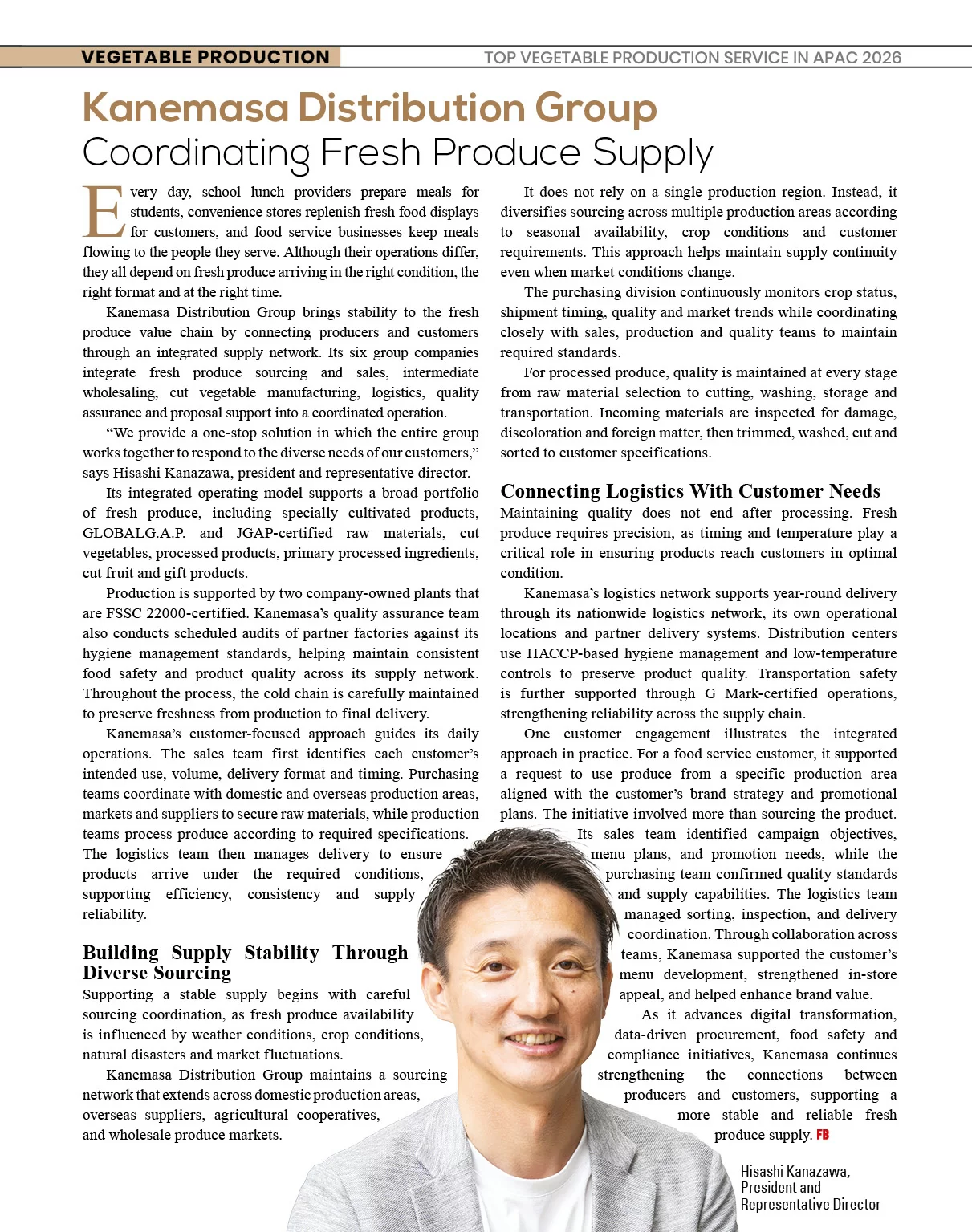
 Hisashi Kanazawa, President and Representative Director
Every day, school lunch providers prepare meals for students, convenience stores replenish fresh food displays for customers, and food service businesses keep meals flowing to the people they serve. Although their operations differ, they all depend on fresh produce arriving in the right condition, the right format and at the right time.
Kanemasa Distribution Group brings stability to the fresh produce value chain by connecting producers and customers through an integrated supply network. Its six group companies integrate fresh produce sourcing and sales, intermediate wholesaling, cut vegetable manufacturing, logistics, quality assurance and proposal support into a coordinated operation.
“We provide a one-stop solution in which the entire group works together to respond to the diverse needs of our customers,” says Hisashi Kanazawa, president and representative director.
Its integrated operating model supports a broad portfolio of fresh produce, including specially cultivated products, GLOBALG.A.P. and JGAP-certified raw materials, cut vegetables, processed products, primary processed ingredients, cut fruit and gift products.
Production is supported by two company-owned plants that are FSSC 22000-certified. Kanemasa's quality assurance team also conducts scheduled audits of partner factories against its hygiene management standards, helping maintain consistent food safety and product quality across its supply network. Throughout the process, the cold chain is carefully maintained to preserve freshness from production to final delivery.
Kanemasa’s customer-focused approach guides its daily operations. The sales team first identifies each customer’s intended use, volume, delivery format and timing. Purchasing teams coordinate with domestic and overseas production areas, markets and suppliers to secure raw materials, while production teams process produce according to required specifications. The logistics team then manages delivery to ensure products arrive under the required conditions, supporting efficiency, consistency and supply reliability.
Building Supply Stability Through Diverse Sourcing
Supporting a stable supply begins with careful sourcing coordination, as fresh produce availability is influenced by weather conditions, crop conditions, natural disasters and market fluctuations.
-
We place importance on understanding how vegetables are used at each customer’s site and coordinate the best possible supply format accordingly.
Kanemasa Distribution Group maintains a sourcing network that extends across domestic production areas, overseas suppliers, agricultural cooperatives, and wholesale produce markets.
It does not rely on a single production region. Instead, it diversifies sourcing across multiple production areas according to seasonal availability, crop conditions and customer requirements. This approach helps maintain supply continuity even when market conditions change.
The purchasing division continuously monitors crop status, shipment timing, quality and market trends while coordinating closely with sales, production and quality teams to maintain required standards.
For processed produce, quality is maintained at every stage from raw material selection to cutting, washing, storage and transportation. Incoming materials are inspected for damage, discoloration and foreign matter, then trimmed, washed, cut and sorted to customer specifications.
Connecting Logistics With Customer Needs
Maintaining quality does not end after processing. Fresh produce requires precision, as timing and temperature play a critical role in ensuring products reach customers in optimal condition.
Kanemasa's logistics network supports year-round delivery through its nationwide logistics network, its own operational locations and partner delivery systems. Distribution centers use HACCP-based hygiene management and low-temperature controls to preserve product quality. Transportation safety is further supported through G Mark-certified operations, strengthening reliability across the supply chain.
One customer engagement illustrates the integrated approach in practice. For a food service customer, it supported a request to use produce from a specific production area aligned with the customer’s brand strategy and promotional plans. The initiative involved more than sourcing the product. Its sales team identified campaign objectives, menu plans, and promotion needs, while the purchasing team confirmed quality standards and supply capabilities. The logistics team managed sorting, inspection, and delivery coordination. Through collaboration across teams, Kanemasa supported the customer’s menu development, strengthened in-store appeal, and helped enhance brand value.
As it advances digital transformation, data-driven procurement, food safety and compliance initiatives, Kanemasa continues strengthening the connections between producers and customers, supporting a more stable and reliable fresh produce supply.
Choosing Vegetable Production Services That Keep Supply Reliable
Fresh produce procurement becomes difficult when menu planning moves faster than farms, processors, kitchens and distribution networks can respond. A restaurant chain may require lettuce that is ready to use immediately, while a school meal provider depends on consistent portion sizes that fit tight preparation schedules. Convenience retailers face another challenge as product development timelines leave little room for ingredient changes once specifications have been finalized. In this environment, commercial vegetable production services are less about growing crops and more about coordinating every step of the supply chain.
Strong providers do not view vegetables as standard inventory. They take time to understand how each product will be used at the customer's site before deciding whether whole produce or pre-cut formats are the better option. Cut size, product yield, storage life and cooking method all influence costs long before food reaches the plate. When the format is not aligned with operational needs, the result is wasted labor, inconsistent portions, rejected deliveries or extra kitchen work that undermines the value of outsourcing.
“Kanemasa Distribution Group delivers consistent quality through integrated operations from sourcing to distribution.”
A broad sourcing network is equally important because relying on a single growing region rarely supports a commercial program over the long term. Weather events, crop quality, natural disasters and market price fluctuations can quickly affect availability, often before purchasing teams have the opportunity to adjust menus or promotions. Buyers should work with suppliers that closely monitor harvest periods, production volumes, quality trends and regional alternatives so sourcing can shift without compromising product specifications. Contract farming strengthens supply stability, but it works best when customer requirements are communicated all the way back to growers instead of ending with procurement teams.
Processing standards deserve the same level of attention. Incoming inspections, washing procedures, temperature management and foreign matter controls determine whether cut vegetables arrive ready to use instead of simply arriving on time. Certifications are useful, but they should support well-established operating practices instead of replacing them. Procurement teams should look for evidence of consistent factory procedures, partner audits, sanitation records and handling standards. An even better indicator is a supplier that can clearly explain every stage between receiving raw materials and shipping finished products without relying on broad food safety claims.
Logistics is often where the difference between promises and day-to-day performance becomes most visible. Store-specific sorting, temperature-controlled storage, limited holding times and year-round delivery capabilities become essential when customers operate with different receiving schedules. A well-managed distribution network helps maintain freshness while reducing waste because shorter storage times lower the risk of quality issues, product claims, disposal costs, labor rework and unnecessary inventory fluctuations. Procurement leaders should look for proof that production planning, warehouse operations, transportation and order management are coordinated as a single service instead of functioning as disconnected processes.
KANEMASA DISTRIBUTION GROUP reflects this approach through an integrated vegetable production service that combines sourcing, cut vegetable manufacturing, quality assurance and logistics. The company works with domestic and international production regions, supplies whole produce as well as prepared formats based on customer requirements and operates company-owned plants certified to FSSC 22000 standards. Its HACCP-based processing centers, 365-day delivery network and G Mark-certified logistics operations help customers maintain product quality and delivery reliability together. For food service operators, school meal providers, prepared food manufacturers and convenience retailers, the company offers a practical option when consistent specifications and dependable supply are essential.
...Read more
Vegetable Production Services in APAC Info
Q1
What Do Vegetable Production Services Include?
Vegetable Production Services cover the activities needed to bring fresh vegetables from growers to foodservice operators, retailers and food manufacturers. These services often include sourcing, cultivation partnerships, processing, quality assurance, cold-chain logistics and distribution planning. By coordinating each stage of the supply chain, providers help maintain product quality, ensure consistent supply and deliver vegetables in the required format and quantity.
Q2
Why Is Kanemasa Distribution Group Recognized Among Leading Vegetable Production Services Providers?
Kanemasa Distribution Group is recognized among Vegetable Production Services providers for its integrated supply network that connects producers and customers through sourcing, intermediate wholesaling, cut vegetable manufacturing, logistics and quality assurance. Operating through six specialized group companies, it serves foodservice businesses, retailers, school lunch providers and convenience stores with tailored fresh produce solutions. Its diversified sourcing network and certified processing operations help support reliable product supply throughout the year.
Q3
What Should Businesses Look for When Choosing Vegetable Production Services?
Selecting the right Vegetable Production Services involves more than comparing product availability. Businesses should evaluate sourcing reliability, food safety practices, processing capabilities, cold-chain logistics and quality assurance standards. Providers with diversified production networks, certified processing facilities and dependable distribution systems are often better prepared to maintain consistent supply despite seasonal changes, weather conditions or shifts in market demand.
Q4
How Do Vegetable Production Services Improve Supply Chain Reliability?
Modern Vegetable Production Services strengthen supply reliability by coordinating sourcing, processing and distribution through a connected operating model. Diversified procurement, crop monitoring, quality inspections, temperature-controlled logistics and well-planned delivery schedules help reduce disruptions while preserving freshness and food safety from production through delivery.
Q5
How Does Kanemasa Distribution Group Support Fresh Produce Customers?
Kanemasa Distribution Group begins by understanding how customers plan to use the product, along with their delivery schedules and processing requirements. It then coordinates sourcing, manufacturing and logistics across its network to meet those needs. With FSSC 22000-certified production facilities, HACCP-based hygiene management, quality audits and nationwide cold-chain logistics, the company consistently supplies whole produce, cut vegetables and processed products that align with customer specifications.
Q6
What Should Organizations Consider When Selecting Vegetable Production Services?
When evaluating Vegetable Production Services, organizations should consider supply stability, quality management, processing expertise, logistics infrastructure and the provider's ability to respond to changing business needs. Companies that bring together sourcing, food safety, manufacturing and distribution within a coordinated operating model are generally better equipped to deliver consistent product quality and dependable long-term supply.
Company :
Kanemasa Distribution Group
Management Hisashi Kanazawa, President and Representative Director
Description
Kanemasa Distribution Group is an integrated fresh produce company providing sourcing, wholesaling, processing, quality assurance and logistics. It delivers a one-stop supply network for food service, retail, school lunch and convenience store customers, ensuring stable supply, food safety and efficient distribution through coordinated domestic and global operations across the value chain.