
Thank you for Subscribing to Food Business Review Weekly Brief


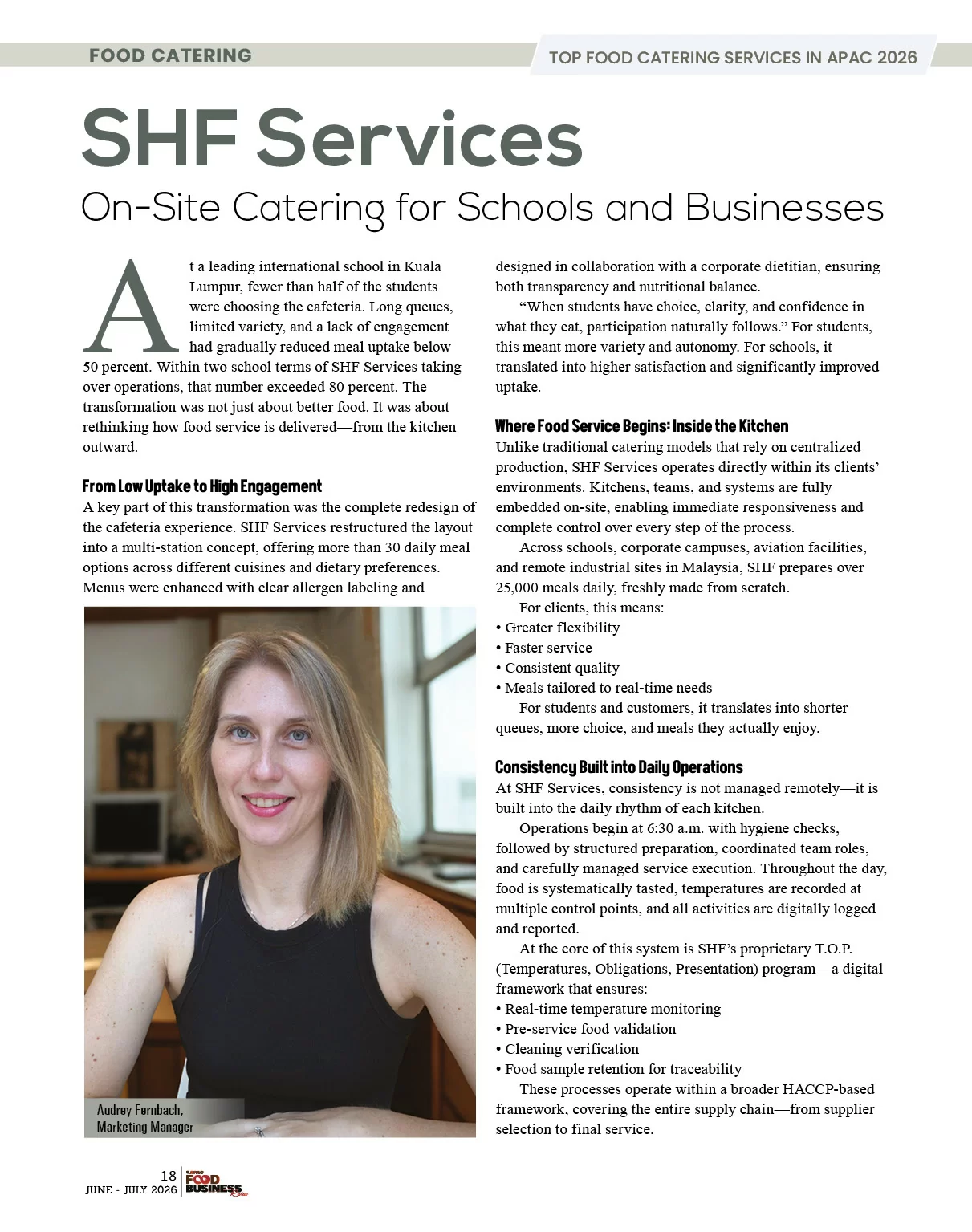
 Audrey Fernbach, Marketing Manager
What factors influence cafeteria participation and meal engagement within school food service environments today?
At a leading international school in Kuala Lumpur, Malaysia, fewer than half of the students were choosing the cafeteria. Long queues, limited variety, and a lack of engagement had gradually reduced meal uptake below 50 percent. Within two school terms of SHF Services taking over operations, that number exceeded 80 percent. The transformation was not just about better food. It was about rethinking how food service is delivered—from the kitchen outward.
From Low Uptake to High Engagement
A key part of this transformation was the complete redesign of the cafeteria experience. SHF Services restructured the layout into a multi-station concept, offering more than 30 daily meal options across different cuisines and dietary preferences. Menus were enhanced with clear allergen labeling and designed in collaboration with a corporate dietitian, ensuring both transparency and nutritional balance.
“When students have choice, clarity, and confidence in what they eat, participation naturally follows.” For students, this meant more variety and autonomy. For schools, it translated into higher satisfaction and significantly improved uptake.
Where Food Service Begins: Inside the Kitchen
How does on-site food preparation improve responsiveness and quality across large catering operations today?
Unlike traditional catering models that rely on centralized production, SHF Services operates directly within its clients’ environments. Kitchens, teams, and systems are fully embedded on-site, enabling immediate responsiveness and complete control over every step of the process.
Across schools, corporate campuses, aviation facilities, and remote industrial sites in Malaysia, SHF prepares over 25,000 meals daily, freshly made from scratch.
For clients, this means:
• Greater flexibility
• Faster service
• Consistent quality
• Meals tailored to real-time needs
For students and customers, it translates into shorter queues, more choice, and meals they actually enjoy.
Consistency Built into Daily Operations
Why are structured operational controls important for maintaining food safety and service consistency daily?
At SHF Services, consistency is not managed remotely—it is built into the daily rhythm of each kitchen.
Operations begin at 6:30 a.m. with hygiene checks, followed by structured preparation, coordinated team roles, and carefully managed service execution. Throughout the day, food is systematically tasted, temperatures are recorded at multiple control points, and all activities are digitally logged and reported.
At the core of this system is SHF’s proprietary T.O.P. (Temperatures, Obligations, Presentation) program—a digital framework that ensures:
• Real-time temperature monitoring
• Pre-service food validation
• Cleaning verification
• Food sample retention for traceability
-
When students have choice, clarity, and confidence in what they eat, participation naturally follows.
These processes operate within a broader HACCP-based framework, covering the entire supply chain—from supplier selection to final service.
 “Our approach is simple,” says Audrey Fernbach, Marketing Manager at SHF Services.
“We don’t just serve meals, we create a controlled, on-site food environment where quality, safety, and consistency are built into every step of the process.”
Nutrition Without Compromise
In what way does nutritional oversight support balanced meal planning across diverse catering environments?
Beyond operational control, SHF places strong emphasis on nutrition and wellbeing.
Menus are designed and reviewed monthly by a corporate dietitian to ensure:
• Balanced nutritional intake
• Age-appropriate portions
• Menu diversity
Cooking methods prioritize baking, grilling, and steaming, while salt, sugar, and fat levels are carefully managed. MSG is excluded, and all suppliers are Halal-certified, with compliance verified through regular audits and unannounced inspections.
A Structured Model Across Diverse Environments
Founded in 2009 and part of Japan’s Green House Group (established in 1947), SHF Services combines international standards with local execution.
Its operations are structured across five specialized brands:
• Delischool – School catering focused on nutrition and student engagement
• FoodCorp – High-volume corporate and industrial dining
• Skyfood – Aviation catering with strict compliance requirements
• La Toque – Premium event catering
• ICOM – Remote and offshore site catering
Each brand operates with tailored service models while adhering to a unified framework of training, quality control, and performance monitoring.
Built for Scale, Designed for Trust
With a workforce of over 400 staff across 10 nationalities, SHF Services has developed a model that balances standardization and adaptability.
Weekly hygiene refreshers, monthly KPI tracking, and cross-site benchmarking ensure that standards remain consistent across all locations.
Today, many client partnerships extend beyond 10 years—a reflection of the company’s ability to deliver not just food, but reliability, accountability, and long-term value.
A New Standard in Catering
In an industry often defined by logistics, SHF Services is redefining catering through control, consistency, and proximity.
By bringing production back into the client’s environment, the company transforms food service into a fully integrated experience—one that is responsive, transparent, and built to perform at scale.
Visit: www.shfservices.com/
What Defines Reliable Institutional Food Catering at Scale
Institutional food catering directly influences employee experience, student participation and day-to-day site operations. Executives evaluating catering partners look beyond menus to assess whether a provider can sustain consistency across locations, respond to fluctuating demand and maintain strict food safety standards. In high-volume environments, breakdowns often emerge through accumulated inconsistencies—temperature lapses, service delays or uneven portioning—that compound into reputational risk and operational friction.
The most credible providers distinguish themselves by exercising direct control over execution rather than relying on fragmented supply chains. On-site preparation using fresh ingredients has become a defining marker of accountability, allowing tighter oversight of quality, nutrition and portion accuracy. This approach reduces dependence on centralized production models, which can introduce variability when scaled across multiple sites. As a result, partners that retain control across the process, from supplier selection through to final service, are better able to maintain consistent standards across sites.
Consistency, however, depends on how standards are executed in daily operations. Structured operating procedures, reinforced through routine audits and continuous staff training, create predictability in environments where volumes and service windows leave little margin for error. The presence of measurable, repeatable routines—covering food safety, preparation and service—reduces reliance on individual staff judgment. For distributed operations, this discipline becomes essential, as remote sites must match the performance of main locations.
Adaptability also plays a decisive role. Catering requirements vary significantly across sectors, from schools requiring nutritional balance and engagement to corporate environments prioritizing speed and throughput. Providers that apply a single operating model across all contexts often struggle to meet these differing expectations. A more effective approach involves tailoring service structures, menus and staffing models to the environment while maintaining common quality control and training standards. This balance between standardization and site-specific adjustments allows organizations to preserve efficiency without compromising relevance.
Workforce readiness influences service reliability. High-performing catering operations rely on clearly defined roles, daily coordination routines and ongoing reinforcement of standards. Regular briefings, performance tracking and cross-site benchmarking align teams and ensure service quality does not drift over time. Executives evaluating partners look for evidence that training is embedded into daily operations, creating a workforce able to maintain service levels during peak demand.
Nutrition has also emerged as a strategic consideration rather than a compliance requirement. Balanced menus, controlled use of fats and sugars and attention to dietary diversity improve meal acceptance and support dietary requirements. Providers that integrate nutritional oversight into menu planning extend their role beyond food provision into meal planning and wellbeing support.
Within this landscape, SHF Services presents a model that aligns closely with these expectations. It operates with full on-site preparation, maintaining direct control over ingredients, cooking methods and portioning while enforcing structured standards across all locations. Its discipline is reinforced through daily checklists, audits and routine training practices that ensure consistency across high-volume environments. The company structures its operations through specialized service brands serving education, corporate and remote settings while maintaining a unified framework of quality control and training. Its focus on nutrition, supported by dietitian oversight and controlled cooking practices, supports consistent meal quality and dietary control. This combination of controlled execution, disciplined systems and structured multi-segment operations allows it to deliver consistent catering across multiple site types at scale.
...Read more
Food Catering Services Info
Q1
What Should Buyers Expect from Food Catering Services in APAC?
Most clients are not expecting luxury dining from a catering company. They just want food that shows up fresh, enough options so people do not complain by Friday and service that can survive a crowded lunch rush. Across APAC, cafeterias deal with short meal windows, uneven foot traffic and customers who notice immediately when something slips. That is why many companies now prefer operators that cook on-site instead of trucking meals in from a distant kitchen.
Q2
How Does SHF Services Approach On-Site Catering?
SHF Services runs kitchens inside the places it serves. That changes the pace of the operation. If a queue suddenly gets longer than expected or a dish is not working, the kitchen can respond right away instead of waiting for the next service cycle. In Food Catering Services in APAC, people usually judge the provider by the fifteen minutes they spend in line, not by what was written in the proposal. SHF currently prepares more than 25,000 meals a day across schools, offices, aviation facilities and remote industrial sites in Malaysia.
Q3
Why Do Menu Choice and Nutrition Matter in Daily Catering?
Anyone who eats at the same cafeteria every day knows how quickly menus can start feeling repetitive. At one international school in Kuala Lumpur, SHF Services reorganized the cafeteria into different stations, expanded the menu to more than 30 daily options and added clearer allergen labels. The change was practical more than cosmetic. Students could move through the space faster and had more freedom to pick meals they were actually interested in eating. Nutrition became part of the routine instead of a separate message on a poster.
Q4
Which Quality Controls Should Catering Partners Show?
The important parts of catering usually happen before customers even enter the dining area. Temperature checks, hygiene reviews, food sampling and cleaning records may not look impressive from the outside, but they are what keep large meal operations stable. In APAC catering environments, where hundreds or thousands of meals may move through a site in a short period, weak systems become visible very quickly. One delayed batch or poorly managed station can affect the rest of the service window.
Q5
How Can Specialized Service Models Support Different Client Sites?
A school cafeteria has different pressures than an airport kitchen or a remote industrial dining facility. SHF Services separates its operations through brands including Delischool, FoodCorp, Skyfood, La Toque and ICOM, allowing each segment to run differently while still following the same operational standards behind the scenes. That flexibility matters because people do not eat the same way in every environment. The pace, expectations and service style shift from one location to another.
Q6
What Signals Long-Term Reliability in a Catering Provider?
Most clients can tell within a few months whether a catering operation is organized properly. Service becomes more predictable, staff know the routine and fewer problems escalate during busy periods. SHF Services employs more than 400 people across 10 nationalities and supports operations with hygiene refreshers, KPI reviews and cross-site performance checks. In large catering environments, reliability usually comes down to whether the operation can repeat the same standard every day without constant intervention from the client side.
Company :
SHF Services
Management Audrey Fernbach, Marketing Manager
Description
SHF Services is a Malaysia-based institutional caterer delivering over 25,000 meals daily across schools, corporate campuses, aviation, and remote sites. Through on-site, from-scratch preparation and standardized systems, it ensures consistent, safe, and nutritionally controlled food service at scale.