
Thank you for Subscribing to Food Business Review Weekly Brief


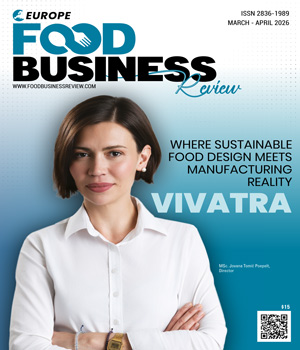
 MSc. Jovana Tomić Poepelt, Director
Food brands and manufacturers lose time and money when promising ingredients fail at the pilot or scale-up stage because formulation choices, processing constraints and regulatory requirements were not addressed early. Vivatra steps in at this stage by designing food products with these constraints considered from the outset, whether using conventional, novel or underutilised ingredients, helping companies reduce trial-and-error, failed pilot runs and avoidable scale-up loops.
Founded in 2025 and operating downstream of ingredient innovation, Vivatra focuses on converting functional ingredient innovation into product-level outcomes. The company integrates formulation, regulation, processing, and sustainability into a single development workflow, so key feasibility decisions are made before resources are committed to pilot trials or industrial-scale up.
AI-Powered Pathways to Better Nutrition
This workflow is powered by the Vivatra Product Design Engine (PDE), a domain-trained, AI-enabled development platform that surfaces viable formulation, processing, and compliance pathways early in development.
Without food-specific systems, teams often run sequential iterations. A formulation that works in the lab fails under production shear or heat. A process-stable product may fall short of labelling or regional compliance requirements. Raw material variability can also affect texture, shelf life, or sensory performance. The PDE moves these checks earlier, narrowing development to pathways that are more likely to scale.
Generic AI tools often underperform in food R&D because they do not account for ingredient variability, process sensitivity, or region-specific regulatory constraints. The PDE is built around these realities, allowing commercial viability, regulatory feasibility, and sustainability to be evaluated together rather than treated as downstream hurdles.
-
Vivatra unites science, AI, and sustainability to help SMEs make earlier development decisions and bring manufacturable, compliant products to market.
As food innovation introduces new functional ingredients, Vivatra provides a predictive formulation and compliance framework that supports their integration across food categories. Solutions are selected using an evidence-led approach that balances scientific validity with production constraints, prioritising what can be manufactured and approved rather than what performs only in concept.
In practice, Vivatra works with alternative protein sources and functional ingredients derived from regional agro-industrial side streams, including brewer’s yeast and sour cherry pits. These are combined selectively with other technologies where they offer clear functional or sustainability benefits. Sustainability is addressed at the design stage by prioritising efficient use of raw materials and reducing waste, and treating side streams as functional components that contribute nutritional, structural, and sensory value.
“Vivatra unites science, AI, and sustainability to help SMEs make earlier development decisions and bring manufacturable, compliant products to market,” says MSc. Jovana Tomić Poepelt, director, Vivatra.
From Ingredients to Market-Ready Food
The impact of Vivatra’s workflow is evident across client projects validated through scale-up trials and pre-launch preparation.
For Natura Gusto, Vivatra developed eight new products, including clean-label Ajvar and sauces in doypack format. These products rely on the natural structural properties of fruits, vegetables, and grains rather than processed stabilisers or emulsifiers.
For Desing Ltd, the team reformulated a HoReCa sauce portfolio, by removing modified starches and unnecessary stabilisers and reducing sugar content by over 30 per cent. Working with Dolovac Organic, Vivatra redesigned fruit rolls into playful “fruit spaghetti,” using apple side streams to prevent agglomeration during storage without the use of anti-caking agents.
In the frozen desserts category, Vivatra formulated a clean-label ice-cream-style product without added sugar or stabilisers, achieving overrun, melting behaviour, and texture comparable to conventional industrial formulations. Several solutions are currently in scale-up or preparation for market launch.
Clients, including Clas Comerc, Lomax Company, and HomeMade Company, value Vivatra’s structured, data-driven development approach combined with a practical understanding of production constraints.
Headquartered at the Science Technology Park in Belgrade and serving clients across Southeast and wider Europe, Vivatra is supported by early-stage strategic investors and academic collaborations with the Faculty of Agriculture at the University of Belgrade. These partnerships support shelf-life modelling, method development, and continued expansion of Vivatra’s validation and deployment capabilities across the European food industry.
Design Intelligence in European Food Biotechnology
European food manufacturers face a structural shift in how products are conceived, validated and brought to market. Precision fermentation, synthetic biology and alternative protein research are expanding the range of available functional ingredients, yet development risk remains high. Fragmented workflows, legacy formulations and iterative bench testing continue to drive costs and delays. Regulatory divergence across markets, raw material variability and sustainability expectations further complicate decision-making. Executives evaluating a food biotechnology partner must look beyond novel ingredients and examine how effectively innovation is translated into manufacturable, compliant and commercially viable products.
The most credible providers integrate scientific modelling, regulatory intelligence and process understanding into a unified development framework. Digital tools that generate theoretical formulations without accounting for processing conditions, shelf-life behaviour or regional compliance requirements rarely survive scale-up. What distinguishes serious platforms is their ability to embed intelligence within real production environments, aligning formulation logic with equipment constraints, supplier realities and cost parameters. Confidence at the design stage reduces failed trials, shortens iteration cycles and clarifies investment decisions.
A second point of differentiation lies in how emerging biotechnologies are applied. Precision fermentation and alternative proteins offer functional and nutritional advantages, but their value depends on predictable performance within finished products. Producers require a predictive formulation approach that evaluates ingredient functionality, stability and regulatory feasibility together rather than sequentially. Integration of side streams from regional agro-industrial processes, such as brewer’s yeast or fruit processing residues, can improve resource efficiency and nutritional profiles, provided their variability and interaction effects are modelled in advance. Practical application and scalability determine whether innovation becomes a commercial asset or remains an experimental exercise.
Environmental performance has also moved upstream into the design phase. Waste reduction, efficient raw material use and clean-label expectations are largely determined before pilot production begins. Food biotechnology partners that treat sustainability as an afterthought introduce risk. Those that incorporate environmental and nutritional parameters into early formulation modelling enable management teams to balance cost, compliance and brand positioning without retroactive reformulation.
Vivatra, headquartered in Belgrade, positions itself within this more integrated model of food biotechnology. Its Vivatra Product Design Engine functions as a domain-trained, data-driven platform that combines food science knowledge, regulatory insight and process modelling to support decision-making early in development. The platform is applied within the client’s existing R&D and production context, evaluating equipment, constraints and raw material variability before formulations are finalised.
Its work spans clean-label sauces, reduced-sugar reformulations, fruit-based structural systems and shelf-stable dairy alternatives. Projects have included significant sugar reduction in HoReCa portfolios, elimination of modified starches and stabilisers and the development of additive-free frozen desserts using fruit side-stream matrices to achieve texture and melting behaviour comparable to conventional formulations. Collaboration with academic institutions supports validation in areas such as shelf-life modelling, while investor backing enables broader deployment across European producers. For executives assessing food biotechnology partners in Europe, Vivatra represents a disciplined choice grounded in integrated design intelligence, regulatory awareness and demonstrated translation of advanced science into scalable products.
...Read more
Company :
Vivatra
Management MSc. Jovana Tomić Poepelt, Director
Description
Vivatra integrates advanced biotechnology with sustainability, enabling producers to create compliant, scalable solutions that reduce waste, improve nutrition and accelerate innovation, ensuring food systems evolve responsibly while delivering products that meet consumer expectations for quality, transparency and environmental impact.